The best signature style for your name depends on its length, strongest letters and how quickly you need to write it. This 21-design gallery makes those choices easier to compare: some examples keep the name readable, others emphasize initials, and several compress long names into a strong visual shape.
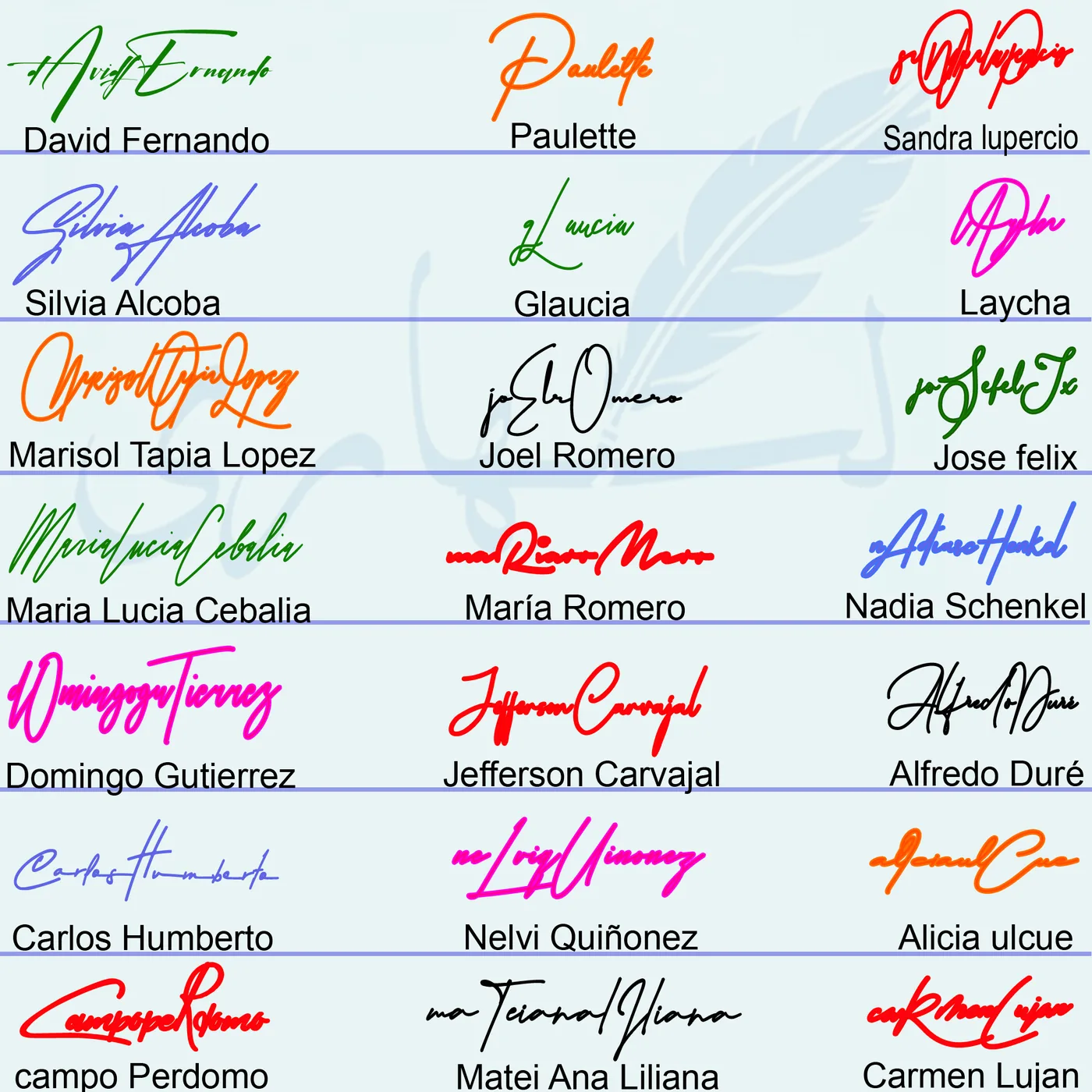
Do not start by asking which signature is the most decorative. Start by asking which structure fits your name and can be repeated at normal speed. The gallery is useful because the same design rule produces very different results on a short name such as Paulette and a longer name such as Marisol Tapia Lopez.
Use this comparison
What the gallery reveals about different name structures
Short names can keep more letters visible
Paulette, Glaucia, Laycha and María Romero have enough visual space to preserve several recognizable letter forms. A short name can use a larger capital without becoming too wide, and it can finish with a modest tail instead of a long underline.
Long names need compression, not more decoration
Marisol Tapia Lopez, Maria Lucia Cebalia, Domingo Gutierrez, Jefferson Carvajal and Matei Ana Liliana show why long names need a hierarchy. One capital or word should lead; the rest can be written smaller. Trying to decorate every section usually creates a slow, crowded signature.
Two-word names benefit from one dominant capital
David Fernando, Silvia Alcoba, Joel Romero, Nadia Schenkel and Alfredo Duré each use the first part of the name to establish direction, while the surname completes the movement. The two words do not need equal size. A smaller surname can make the whole design faster without removing its identity.
Abstract styles still need a repeatable outline
Sandra Lupercio, Jose Felix, Nelvi Quiñonez and Carmen Lujan are more compressed and stylized. Their usefulness comes from the outline—height, width, slant and ending—not from perfect letter recognition. If that outline changes every time, the design is too complex for daily use.
Choose the right signature style family
| Style family | Best for | What to keep consistent |
|---|---|---|
| Readable cursive | People who want most of the name visible | Capital size, baseline and word spacing |
| Initial-led signature | Long names or fast everyday signing | Shape of the main initial and direction of the body |
| Two-capital signature | First name plus surname | Relative size of both capitals and the connection between them |
| Compact abstract mark | Very quick personal signing | Overall silhouette, crossings and final stroke |
| Underlined signature | Short or narrow names that need visual width | Length and angle of the underline |
The cursive name signature gallery gives more detail on connected lettering. For an online preview workflow using names written in Latin letters, see signature styles for a name in English letters.
Five questions to choose a signature style for your name
- How many parts of the name will you use? Compare a full name, first name, surname, initials and first initial plus surname.
- Which letter has the best natural movement? The most comfortable capital is usually a better anchor than the most complicated-looking one.
- How often will you write it? A frequent signature should have fewer fragile loops and pen lifts than an occasional autograph.
- How much readability do you want? Decide whether the full name, only the initials or simply the overall shape should be recognizable.
- What size is realistic? Test the design in the small spaces used on forms instead of judging only a large practice version.
Test three versions before choosing
Create three drafts with the same name format so you can compare one change at a time:
- Version A—readable: visible capital, recognizable middle letters and a short ending.
- Version B—balanced: larger initial, compressed middle and one controlled flourish.
- Version C—compact: initials or a shortened name with a stable underline or crossing stroke.
Write each version five times without slowing down. The winning option is not automatically the prettiest single attempt. It is the version whose width, slant, main capital and ending remain most consistent.
Choose the structure first and the decoration second. When the structure fits your name, even a simple signature can look finished.
Move from an idea to a usable signature
Once one version feels reliable, practise it at normal size for several sessions. If you also need a clean image for documents or design work, create the handwritten version first, then scan or photograph it and remove the background. The tools hub can help with drawing, cleaning and practice workflows without changing the original URL structure of this article.
Frequently asked questions
What is the best signature style for a long name?
A dominant initial with a compressed surname or a first-initial-plus-surname format is usually more practical than writing every letter at equal size.
Should my first and last name both be readable?
Only if that is your preference. Many useful signatures make one part readable and simplify the other. The important choice is consistency, not complete legibility.
How many styles should I test?
Three distinct structures are enough for an initial comparison. Testing too many decorative variations at once makes it difficult to identify which change actually helps.
Can I change my signature style later?
You can refine a personal signature over time. For important official uses, consider the practical consequences of changing an established signature and keep the version you use consistent.
Single Signature Examples from This Collection
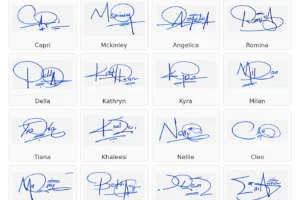
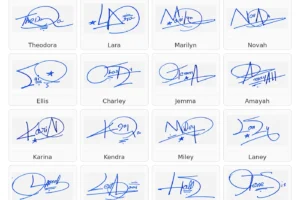
These individual handwritten signature images are included as supporting examples so visitors can compare one name at a time. Each caption preserves the name reference and makes it easier to study initials, loops, finishing strokes and overall signature flow.

Add Comment