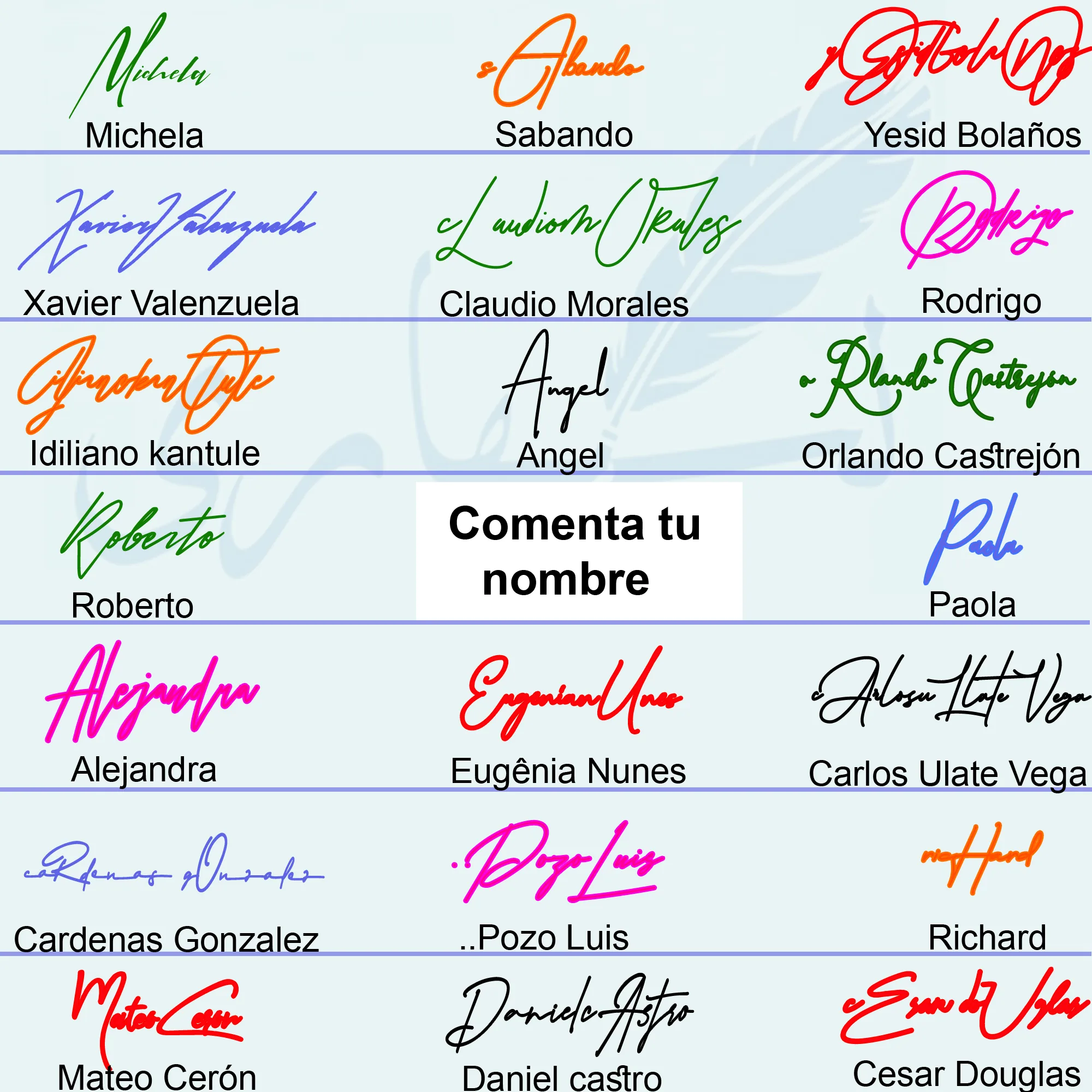
These signature examples for your name show 21 ways to combine initials, full names, compact lowercase strokes, loops, underlines and long finishing lines. The value of the gallery is not to copy one signature exactly, but to identify a structure that fits the length and movement of your own name.
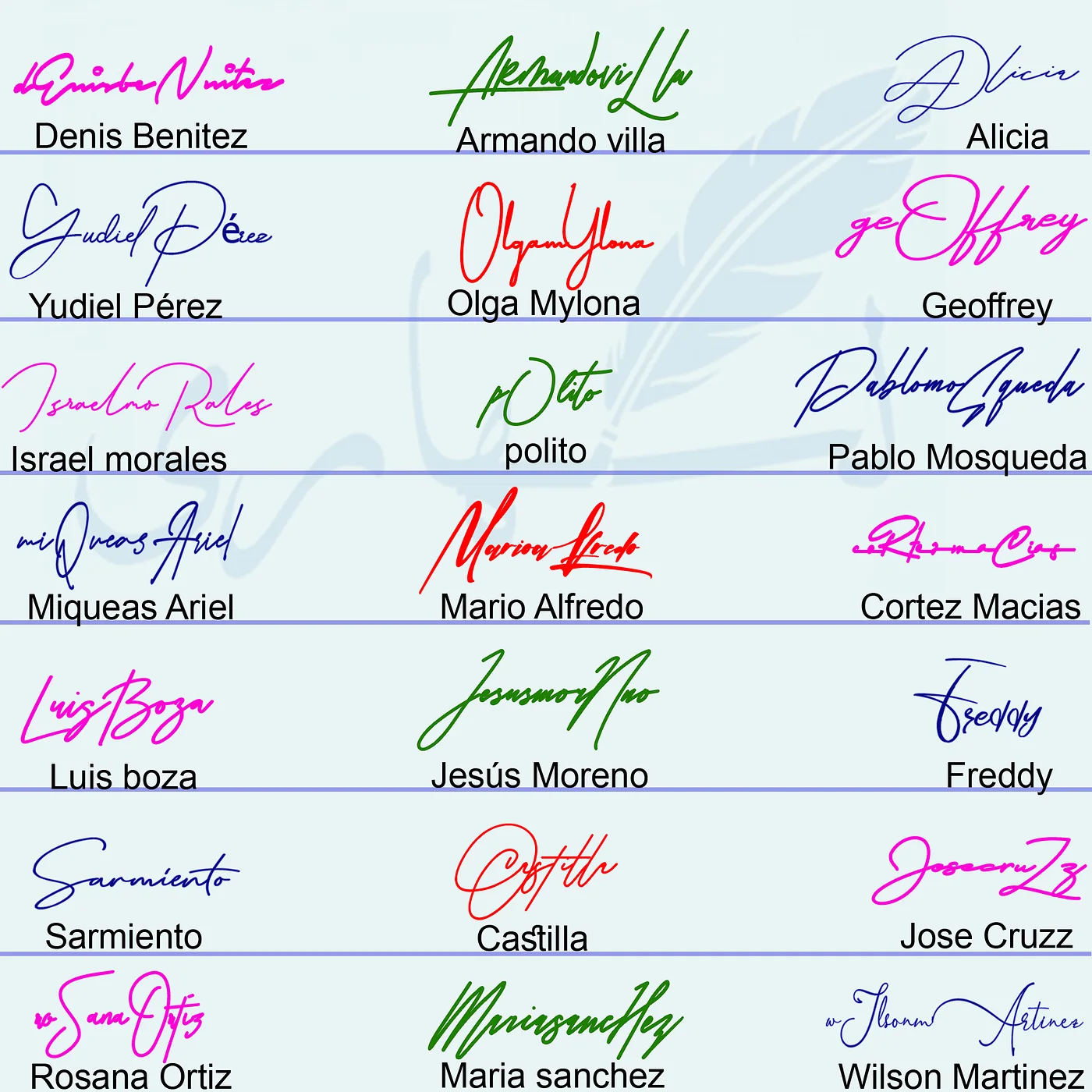
Look first at the large capital letters, then at how the smaller letters are shortened or connected. The most useful idea is often the relationship between those parts: one focal initial, one continuous direction and one controlled ending.
In this guide
- Read the gallery by structure
- Choose a format for your name
- Evaluate repeatability
- Adapt an example safely
What the 21 name signature examples show
Oversized initials create a clear focal point
Alicia uses a large open A that carries most of the visual identity. Olga Mylona begins with a tall oval O, while Geoffrey enlarges the G and keeps the remaining letters lighter. Yudiel Pérez gives both Y and P a strong presence, making the two-word name feel balanced rather than allowing the surname to disappear.
Two-word names work best with a hierarchy
Armando Villa, Pablo Mosqueda, Mario Alfredo and Wilson Martinez do not give every letter equal emphasis. Their designs use one or two larger capitals while the remaining strokes move more quickly. This hierarchy keeps a full-name signature from becoming a long line of equally detailed cursive.
Short names can carry more visible letter detail
Polito, Freddy, Castilla and Sarmiento have enough space to keep several recognizable letters. Their examples show that a short signature does not have to be initials-only; it can remain readable while still using a long entry curve or finishing stroke.
Underlines should grow from the writing movement
The strongest underlines in the collage feel connected to the last letter or final capital. Armando Villa and Mario Alfredo use extended finishing strokes that support the name rather than placing an unrelated line beneath it. This makes the design quicker and more coherent.
Multiple capitals can distinguish a two-part name
Names such as Miqueas Ariel, Rosana Ortiz and Maria Sanchez use separate capital movements to signal the change between first and last name. The key is scale: when both capitals are equally ornate, the signature can become crowded. A primary capital and a smaller secondary capital are usually easier to repeat.
Choose a signature format for your own name
| Name situation | Gallery direction to study | Practical reason |
|---|---|---|
| Short single name | Alicia, Freddy, Polito or Sarmiento | More of the name can remain readable without making the signature too long |
| Two medium-length names | Armando Villa, Olga Mylona or Mario Alfredo | One large initial plus compact connected letters creates hierarchy |
| Long first and last name | Pablo Mosqueda or Wilson Martinez | Emphasize capitals and simplify the middle strokes |
| Two strong initials | Yudiel Pérez or Rosana Ortiz | Use a clear transition between the capitals |
| Need a quick signature | Castilla or Sarmiento | Use one main movement and a restrained ending |
The same name can be designed in several valid ways. Before choosing, compare the broader guide to different signature styles, including cursive, minimalist, initial-based and underlined forms.
Which examples are easiest to repeat?
Repeatability depends more on movement than on appearance. A design with one large loop and a direct exit can be easier than a smaller signature made from several separate pen lifts. In this gallery, the compact examples for Freddy, Sarmiento and Castilla have relatively simple movement, while the more decorative forms for Geoffrey, Yudiel Pérez and Rosana Ortiz would require more deliberate practice.
- Count pen lifts. Fewer interruptions usually make a design faster and more consistent.
- Watch crossing points. A crossing that lands in a different place each time can change the whole shape.
- Protect the main initial. The opening letter should remain recognizable even when the smaller strokes become quicker.
- Simplify long names. Reduce internal detail rather than shrinking every letter until the signature becomes cramped.
- Test on a signature line. A design that fits a blank page may be too tall or wide for everyday forms.
How to adapt a signature example without copying it
- Choose a structural idea, not a finished autograph. Select “large initial plus compact surname” or “two capitals with a shared underline.”
- Write your own name normally. Identify the letters your hand already connects easily.
- Transfer only one feature. Try the initial size, underline direction or compact middle—not all decorative details at once.
- Make three variations. Compare a readable version, a shorter version and a more expressive version.
- Practise at realistic speed. Keep the version whose core shape survives repeated writing.
Letter-specific practice can also help. For example, the letter E signature guide shows how one initial can be developed into looped, compact, monogram and surname-connected formats.
Frequently asked questions
What is the best signature for my name?
The best design is one that suits your name length, feels natural in your hand, remains recognizable at normal size and can be repeated without carefully drawing it.
Should I use my full name or initials?
Use a full name when you want more readable identity and the name is comfortable to write. Use initials or an initial-plus-surname structure when speed and compactness matter more.
Can I copy one of these signatures?
Use the gallery for design inspiration rather than copying another person’s exact mark. Adapt the structure to your own letters and natural hand movement.
How many capitals should a two-word signature have?
Two capitals can work well, but one should usually be the main focal point. Keeping the second smaller prevents the design from becoming visually crowded.
Do I need an underline?
No. Add one only when it grows naturally from the final stroke and improves the composition without making the signature harder to repeat.
Single Signature Examples from This Collection
These individual handwritten signature images are included as supporting examples so visitors can compare one name at a time. Each caption preserves the name reference and makes it easier to study initials, loops, finishing strokes and overall signature flow.

Add Comment